


How Do AI Glasses Hear You
A pair of audio AI glasses can hear you through multi-microphone arrays combined with beamforming and environmental noise suppression. Because a wearable sits farther from the mouth than a phone, it has to isolate speech from traffic, wind, and nearby conversation before any AI system can process it.
Microphone Arrays and Voice Capture
Most AI glasses place several microphones along the temple arms, continuously comparing the sound each one picks up to separate the wearer's voice from ambient noise. Beyond wake-word detection, the same arrays feed contextual audio into features like live transcription and captions and real-time translation — the raw material every downstream AI feature depends on.
Beamforming and Noise Suppression
To improve clarity, most AI glasses rely on beamforming and environmental noise suppression. Beamforming uses timing differences between microphones to build a directional listening zone around the speaker while suppressing everything outside it. Noise suppression filters wind, traffic, and crowd sound before the signal reaches the AI system.
Without these two steps, voice-controlled wearables struggle badly in places like airports, cafés, or train platforms.
Featured Tech: MemoMind One Hardware Audio
The MemoMind One uses three microphones built into its temples, running three AI beamforming modes — Meeting, Translation, and AI Conversation — that shift the listening priorities of the array depending on what the wearer is doing.
How Do AI Glasses Process Information
Capturing clean audio is only the first step. Once the microphones isolate speech, the glasses have to turn that sound into something useful — and that's where the real complexity lives.
From Sound to Text
The first step is speech recognition: converting the sound of your voice into written text. Most AI glasses support two modes — an online mode that uses a larger cloud model for higher accuracy, and an offline mode that runs a lighter model directly on the device for when you don't have internet.
From Text to Understanding
Text alone isn't enough. The glasses need to figure out what you mean — whether you're asking a question, setting a reminder, or starting a translation. Natural language understanding parses your intent and extracts key details like names, times, and topics. Large language models then handle the heavier work: conversational responses, meeting summaries and recordings, memory extraction, and semantic search across past recordings.
From Understanding Back to You
Once the AI knows what you need, it generates a response — a translated sentence, a spoken answer, a summary, or a saved note. That response reaches you either as text on the display or as voice through the open-ear speakers. Recordings and summaries are also stored and indexed so you can search them later by meaning, not just keywords.
How MemoMind One Does It
MemoMind One follows this same pipeline. Its three built-in microphones support different audio processing modes for meetings, translation, and AI conversations. Captions supports online and offline speech recognition, while Translator handles real-time multilingual conversations. The Recorder can generate speaker-separated transcripts and structured AI summaries, including key points and action items. Memo AI and Memo+ add a personal context layer that helps users work with relevant information across supported interactions.
How Do AI Glasses Deliver Audio Without Earbuds
AI glasses deliver sound through open-ear acoustic systems positioned just above the ear canal. Unlike earbuds that seal off the ear, open-ear speakers keep the wearer aware of traffic, conversation, and their surroundings while still delivering private audio feedback.
Open-Ear Audio Systems
Most AI glasses place a miniature directional speaker inside each temple, aimed downward toward the ear opening rather than into it. This keeps users socially and spatially aware while still delivering navigation prompts, calls, AI responses, and translation audio — one reason open-ear audio has become the default across lightweight AI eyewear.
The Reality of Sound Leakage
Because the speaker sits outside the ear canal, controlling sound leakage is one of the hardest problems in wearable audio. Ray-Ban Meta, Even Realities, and every other brand building on an open-ear architecture face the same physics — leakage can be reduced, not eliminated — which is why it remains one of the most active areas of engineering across the AI eyewear industry.
Regarding sound leakage, we have conducted internal testing on MemoMind One.
How Do AI Glasses Display Information
Not every pair of AI glasses has a display — many rely on audio alone, using voice as the only interface. But for the models that do add one, it's typically built from miniature projection systems paired with optical waveguides embedded in the lens. Projecting a readable image is hard enough; doing it while keeping the frame light, visually unremarkable, and legible outdoors is what separates good implementations from bad ones.
Projection and Waveguide Optics
Most modern AI glasses use compact MicroLED or MicroOLED projectors paired with diffractive waveguides — thin, transparent optical elements built into the lens that route light toward the pupil. Earlier smart glasses relied on thicker prism-based optics that made the device look bulky; diffractive waveguides with microscopic grating structures allow thinner lenses and a more ordinary appearance.
Outdoor Visibility
Outdoor readability remains one of the biggest limits in wearable displays. Under direct sunlight, a low-brightness projector washes out, forcing the wearer to shade the lens or step into shadow. Balancing high brightness against a lightweight optical structure is one of the harder trade-offs in consumer AR eyewear.
One Example: MemoMind One Display
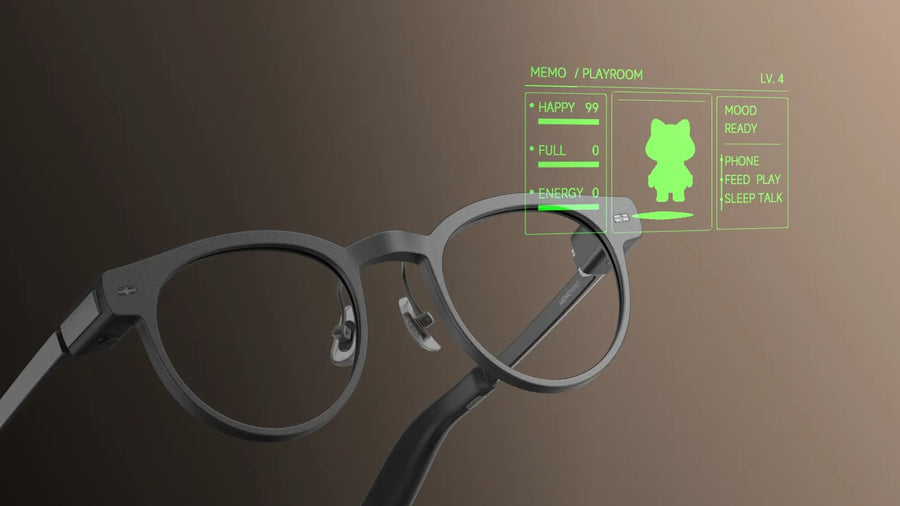
The MemoMind One combines a diffractive waveguide with a high-efficiency MicroLED projector rated up to 2,000 nits in-eye brightness. Its single-zone 2D grating keeps the lens close to transparent to onlookers while pushing brightness high enough for outdoor use. Display settings — projection distance, height, brightness, and per-app font layout — are software-adjustable, so the same hardware serves teleprompter text, navigation, captions, and notifications.
How Do AI Glasses Connect to Phones and the Cloud
Most AI glasses aren't fully standalone — they pair with a phone over Bluetooth and lean on it, or the cloud beyond it, for anything heavier than basic voice commands. This connection carries paired notifications, offloads AI processing too demanding for the glasses' own chip, and syncs settings or recordings back to a companion app.
Connectivity quality directly affects how the glasses feel to use: a weak or dropped connection turns an instant AI response into a multi-second wait. When Bluetooth disconnects, cloud features — translation, AI summaries, voice assistant — stop working, while on-device features like offline transcription and display settings continue. Most AI glasses have no standalone Wi-Fi; they rely on the phone's internet connection.
How MemoMind One Connects
MemoMind One pairs with your phone via Bluetooth through the MemoMind app. First-time setup is guided in-app; once paired, the glasses reconnect automatically when you put them on and your phone is in range. The phone handles app logic and internet access; the glasses handle audio I/O, display rendering, and on-device processing.
Why Wearability Remains an Engineering Trade-off
Every component covered so far — microphones, batteries, displays, speakers — has to fit into a frame that still looks and feels like ordinary glasses, and that constraint drives most of the hard trade-offs in AI eyewear. More microphones improve voice capture but add weight and power draw. A brighter display improves outdoor visibility but shortens battery life. A bigger battery extends use time but pushes the frame's weight and balance past what's comfortable for all-day wear.
This is why AI glasses tend to specialize rather than try to maximize every spec at once — a device built for all-day comfort makes different trade-offs than one built for maximum display brightness or the longest possible battery life.
Where MemoMind One Lands
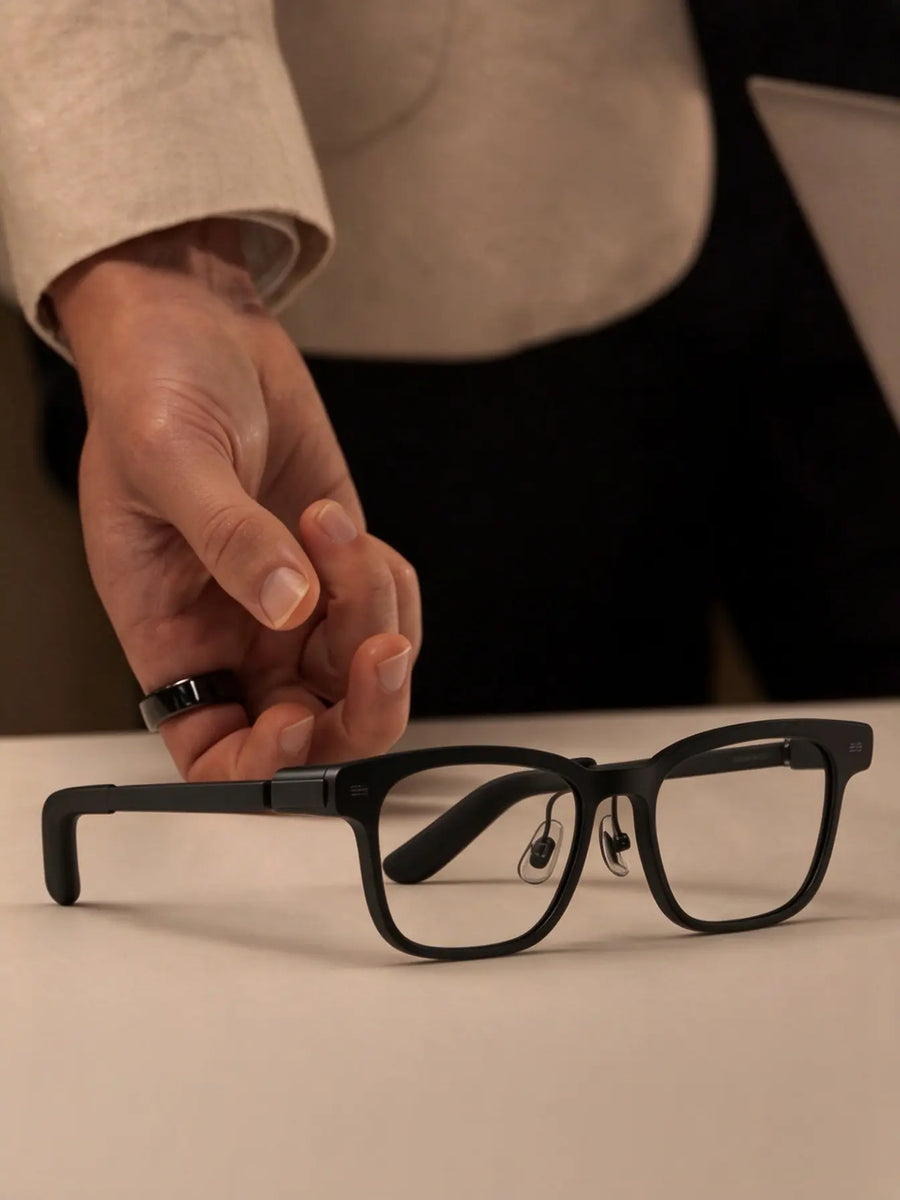
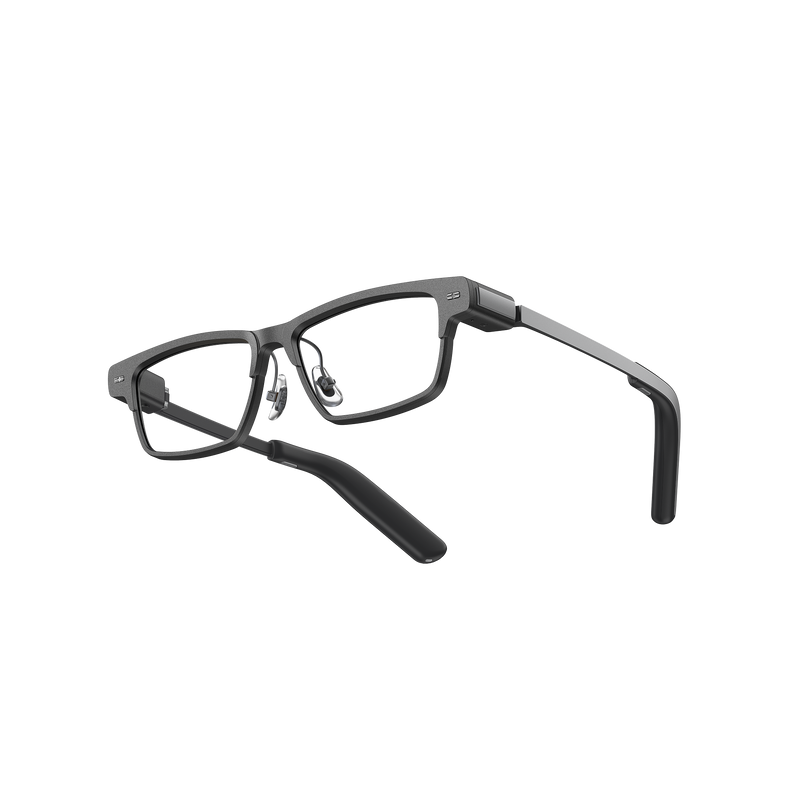
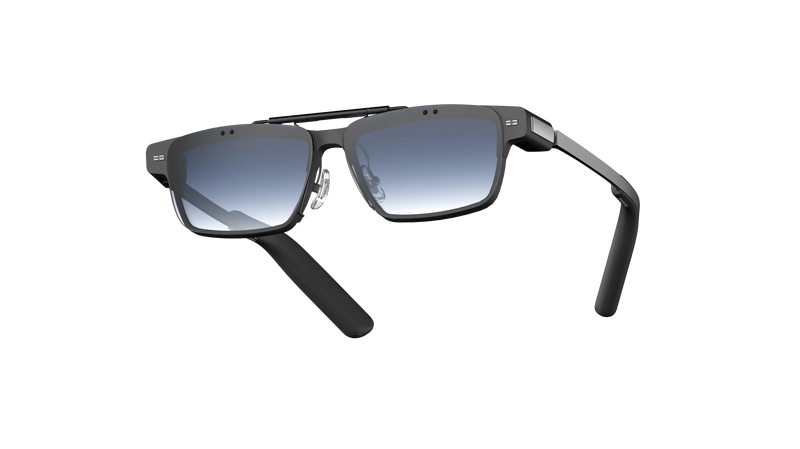
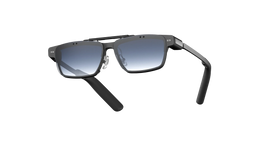
MemoMind One prioritizes all-day comfort and a normal-glasses appearance over maximum specs. At approximately 46.6 grams, it's comparable to regular prescription glasses, with weight distributed across the temples and nose bridge rather than concentrated at the front. It supports prescription lenses and an optional sunglass clip-on, and the camera-free design is itself a wearability choice — removing the camera module saves weight and bulk while eliminating the social awkwardness of wearing a visible camera on your face.
The trade-off: display FOV and battery capacity are more modest than on glasses built to maximize those specific specs. That's an intentional choice for a device meant to disappear on your face rather than impress on a spec sheet.
Privacy in AI Glasses
Camera-equipped AI glasses raise an obvious privacy question: who's aware they're being recorded, and when. Some manufacturers address this with recording indicator lights; others remove the camera from the design entirely.
The MemoMind One takes the second approach — it ships with no camera at all, so voice and audio remain the primary inputs the AI system can use.
FAQs
What are AI glasses?
AI glasses are wearable devices that combine traditional eyewear with technologies such as microphones, speakers, sensors, displays, and AI software. Depending on the model, they can respond to voice commands, translate conversations, provide navigation, capture notes, or display information without requiring users to constantly look at their phones.
What do AI glasses do?
They capture speech and environmental audio, process it through AI models locally or in the cloud, and respond through a miniature display, audio, or a paired app — covering tasks like navigation, live translation, transcription, and voice assistance.
Why do some AI glasses remove cameras?
Removing the camera eliminates the most sensitive privacy question in wearable tech — bystander consent — and lets the design center on audio and display features instead, without built-in recording capability.
Are camera-free AI glasses better for privacy?
They remove one entire category of privacy risk — unauthorized recording of bystanders — though voice capture still needs its own safeguards, such as on-device wake-word detection or voiceprint recognition, to limit what audio gets processed and by whom.