"Can Other People Hear Your AI Glasses?"
Honestly, people nearby may hear faint audio at close range or high volume, especially in quiet spaces. In typical everyday environments, background noise can make that leakage less noticeable.
MemoMind One Internal Sound Leakage Test: Key Findings
-
Sound leakage is not a MemoMind-One-specific flaw. Almost every open-ear smart glasses design leaks sound to some degree — that's inherent to how open-ear audio works, not unique to any one product.
-
Firmware has measurably reduced it. Since release, the Team has continuously optimized MemoMind One AI display glasses, and the latest firmware has cut overall sound leakage by 5 to 10 decibels.
-
At normal volume, it's basically a non-issue. In most everyday environments — roughly 40–60 dB(A) of ambient noise, the range of a typical office or living room — listening at a comfortable volume no longer produces noticeable leakage from MemoMind One.
How We Tested It
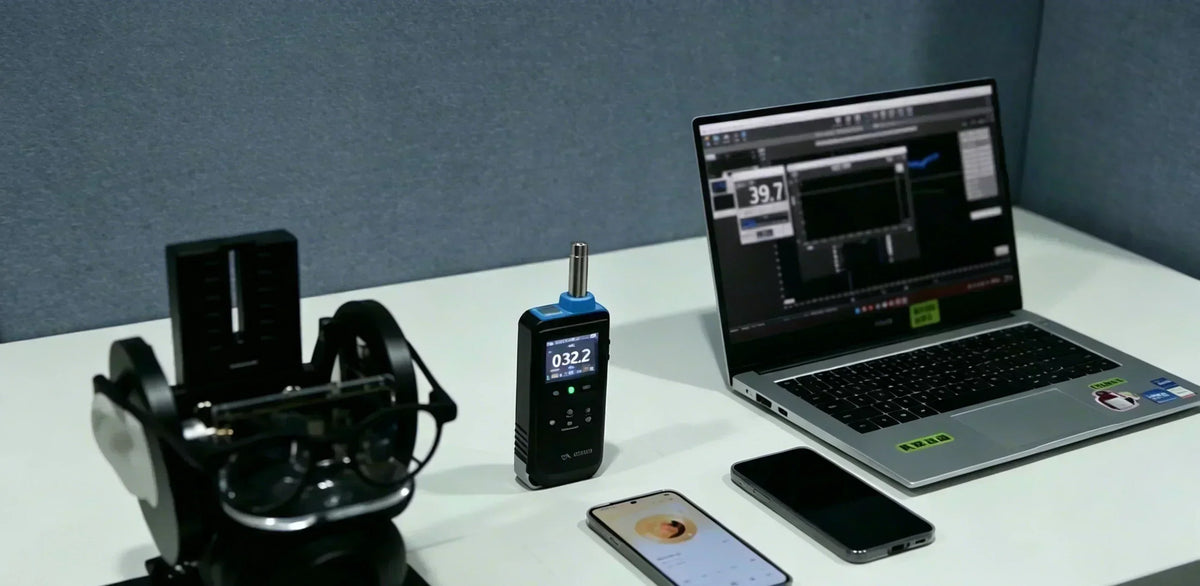
The MemoMind team conducted internal tests on three MemoMind One firmware versions(April Initial, July, and the Latest).
Two typical listening scenarios were chosen:
-
An anechoic environment
-
An ambient noise environment
All tests adopted a consistent wearing position, playback volume, and audio track. Sound leakage was then measured at three distances:
-
At-ear
-
30 cm (approximately arm's length)
-
1 meter (a typical conversational distance)
This setup created a total of six distinct measurement groups — 3 distance readings taken in each of the two environments — to quantify how firmware iterations alter audio sound leakage.
What We Found
Across this internal test, sound leakage decreased by between 5 and 10 dB from our April firmware to the latest one. More importantly, every firmware update showed measurable improvement, demonstrating that reducing sound leakage has been an ongoing engineering priority for the MemoMind team rather than a one-time optimization.
With the newest firmware, measurements show an approximately 10 dB reduction at the ear. The reduction may not seem particularly dramatic. However, as a general rule in acoustics, a 10 dB change is perceived as roughly twice or half as loud to the human ear. This means the wearer hears a much lower volume, while less sound escapes into the surrounding environment as well.
The reductions measured at 30 cm and 1 meter were more modest. Because once sound leaves the speakers, it mixes with reflections, ambient room noise, and other environmental sounds that firmware cannot control.

Note: readings in the ambient noise environment reflect total sound pressure at the measurement point (ambient noise plus device output combined)
Does Sound Leakage Mean Poor Privacy?
There's a real difference between "Someone noticing your glasses are playing something" and "Someone actually making out what you're listening to".
Test results show that while MemoMind One may exhibit slight sound leakage at close range when the volume is high, it is difficult for bystanders to distinguish that from the ambient noise in a typical, bustling environment. This means under identical listening conditions, the MemoMind One significantly reduces the chance of your audio playback drawing unwanted attention from people nearby. Lower sound leakage greatly reduces the chance that bystanders can clearly distinguish the audio content as well.
Therefore, you can choose this most natural AI eyewear for all-day use.
Why MemoMind Chose Open-Ear Audio Anyway?
If total acoustic isolation were the goal, earbuds would win every time.
But AI glasses aren't earbuds — they're built to stay part of your day, not shut them out. Whether you're getting walking directions, checking your calendar, or glancing at notes before a meeting, staying aware of what's around you matters. Open-ear audio keeps that connection intact without asking you to take your glasses off.
How to Minimize MemoMind One’s Sound Leakage?
-
Keep your volume no higher than you need. Cranking it up past what's comfortable barely improves your own listening experience, but noticeably increases what others nearby can hear.
-
Update your firmware. Each release includes speaker and volume tuning improvements — our own testing shows real, measurable gains from version to version.
-
Be extra mindful in silent spaces. In a library or a quiet meeting room, dial your volume down a notch to stay discreet.
Still deciding whether MemoMind One fits your daily routine? Our AI glasses Buyer's Guide covers display quality and battery life and the latest side-by-side comparisons.