Skip to content

Cart

Your cart is empty

Continue shopping

Welcome to MemoMind Customer Service Support.

Let's get this conversation started. Please fill in the following information and we'll get in touch with you within 24 hours.

Can You Actually Wear AI Glasses All Day? MemoMind One Answers

Can You Actually Wear AI Glasses All Day? MemoMind One Answers
Can AI glasses actually stay comfortable, useful, and unobtrusive enough to wear all day?
For many products on the market today, that's still a challenge. MemoMind One was designed to answer this question: whether people would genuinely want to wear it from morning to night.

Why "Everyday" Is the Hardest Test Any AI Glasses Can Face

Wearables get judged in controlled conditions. They get worn in real ones.
You're commuting. You're in back-to-back meetings. You're picking up your kid. You forget you're wearing technology — and then it works anyway.
That's the real test of an everyday AI wearable. Not specs in a vacuum. Not a showroom demo. The question is whether glasses disappear into your life or interrupt it.
Most AI glasses today still face three common challenges:
• They become uncomfortable during extended wear due to weight or ergonomics.
• Their displays require trade-offs between visibility, comfort, and everyday wearability.
• Battery life often limits continuous all-day use.
MemoMind One is designed, from frame to firmware, to pass all three.

Full-Day Comfort: The Design Behind All-Day Wear

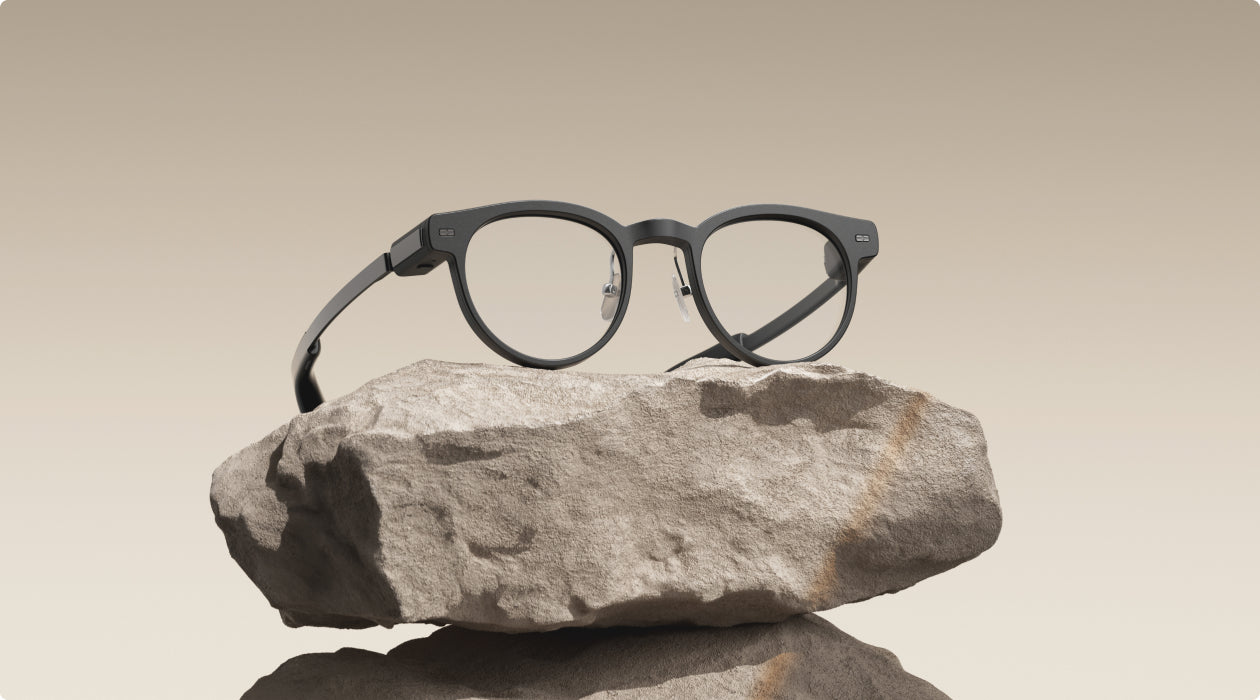
Full-day comfort starts with a design that earns it. MemoMind One follows traditional eyewear ergonomic standards while integrating AI hardware in ways you won't feel:
MemoMind One's hinges pass over 10,000 open-and-close cycle tests, delivering stable long-term daily use free of wobble. Matched with beta-titanium arms, these wide-angle elastic hinges automatically conform to various head sizes and prevent pinching even after two hours of wear.
Core components stacked behind the ear — low visible profile, optimal pressure distribution.
Magnesium-aluminum alloy frame — for the same volume, it is approximately 33% lighter than traditional aluminum alloys and about 60% lighter than titanium alloys. Widely used in aerospace and automotive lightweighting engineering, this alloy enables weight reduction while maintaining structural strength.
Beta-titanium temples — highly elastic, corrosion-resistant, and hypoallergenic for comfortable all-day wear. A premium material commonly found in high-end eyewear and aerospace applications.
Some AI glasses that use magnetic lens frames add bulk, create pressure points, and introduce dust and visual interference over time. MemoMind One uses a single-body bonding process that eliminates those tradeoffs.

Full-Day Display: A Screen You See, Not One Others Do

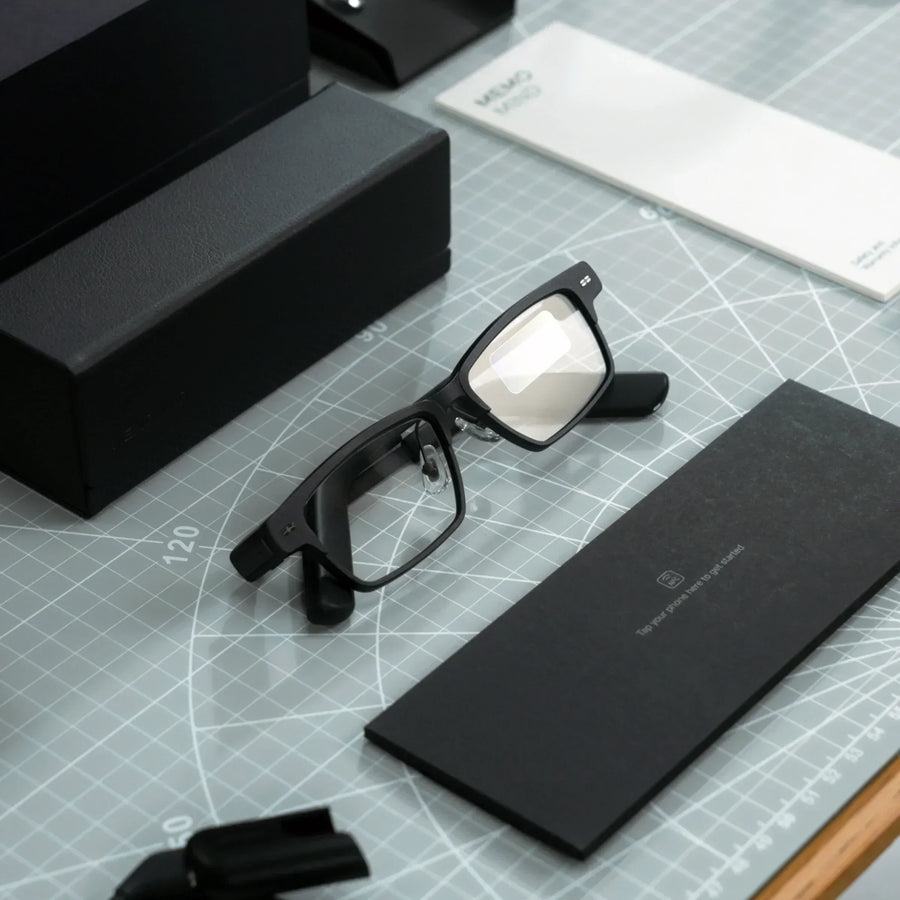
MemoMind One uses waveguide AR display technology with a 2D grating design—an advanced optical architecture that delivers a compact form factor and a clear viewing experience. Depending on the optical architecture, current AR glasses typically use either 1D or 2D diffraction grating waveguides, each involving different engineering trade-offs. MemoMind One adopts a different optical approach optimized for its product goals.

• Only one visible grating zone on the lens.
• 98% light transmittance makes the waveguide area nearly invisible to others.
• The grating sits above the central visual field — it doesn't compete with what you're actually looking at.
• Proprietary waveguide light path: display content is optically private — invisible from the front.
This design helps make AR information less visually noticeable in everyday environments such as offices, cafés, or public transportation.
Feature MemoMind One Rokid Inmo
Display height adjustment
Display distance (1–5 m)
Brightness adjustment Auto Manual only Manual only

Full-Day AI: Ready Whenever You Need It

For an AI wearable to be useful throughout the day, technology needs to fit naturally into existing routines.
Rather than requiring constant interaction, MemoMind One focuses on reducing the number of times users need to reach for their phones.
Memo Memory automatically converts spoken information into structured text memories throughout the day. Instead of relying on manual note-taking, users can revisit important conversations, ideas, reminders, and moments later through their personal memory library.
At the end of the day, AI-generated summaries help organize key events and insights.
Besides, real-time translation, navigation guidance, captions, reminders, and schedule information are available directly through the glasses when needed, reducing interruptions and helping users stay focused on what they're doing.

Full-Day Battery: 16+ Hours So You Don't Have to Think About It

A pair of glasses you have to take off to charge isn't a pair of glasses you wear all day.
MemoMind One is powered by a custom battery designed specifically for its compact form factor. Together with efficient hardware and software optimization, it provides up to 16+hours of mixed use on a single charge.
From morning alarm to post-dinner conversation, these long-lasting AI glasses help minimize interruptions caused by charging throughout the day.

FAQs

Can I Really Wear MemoMind One All Day?

MemoMind One was designed with all-day wear in mind. Instead of focusing only on AI features, it also addresses the practical challenges that often limit wearable devices, including comfort, battery life, display usability, and privacy. With a lightweight frame, balanced weight distribution, a private AR display, and 16+ hours of battery life, it is built to stay useful throughout a full day rather than only during short interactions.

What Makes MemoMind One Comfortable for Extended Wear?

Long-term comfort depends on more than overall weight. MemoMind One combines lightweight materials, flexible hinges, and a balanced hardware layout to reduce pressure during extended use. The frame uses magnesium-aluminum alloy and beta-titanium components, while key electronics are positioned behind the ears to help distribute weight more evenly. The result is a design intended to feel closer to traditional eyewear than a wearable gadget.

Will the Display Distract Me During Daily Activities?

The display is designed to provide information when needed without constantly competing for attention. MemoMind One places its AR display above the central field of vision, allowing users to remain focused on conversations, work, or their surroundings while still accessing translations, navigation, reminders, and other information at a glance. Because the display is not positioned directly in front of the wearer's primary line of sight, it is designed to feel less intrusive during everyday use.

Related Blogs

More MemoMind stories from the same category.
Tech Hub Jul 14, 2026

MemoMind One Battery Test: Runtime, Power Consumption & Charging Speed

Tech Hub Jun 15, 2026

Do We Really Need AI powered Smart Glasses? A Reality Check For 2026

Tech Hub Jun 08, 2026

How Do AI Glasses Work? Inside the Next-Gen Tech(2026)