MemoMind One Media Reviews: XGIMI’s Camera-Free AI Smart Glasses
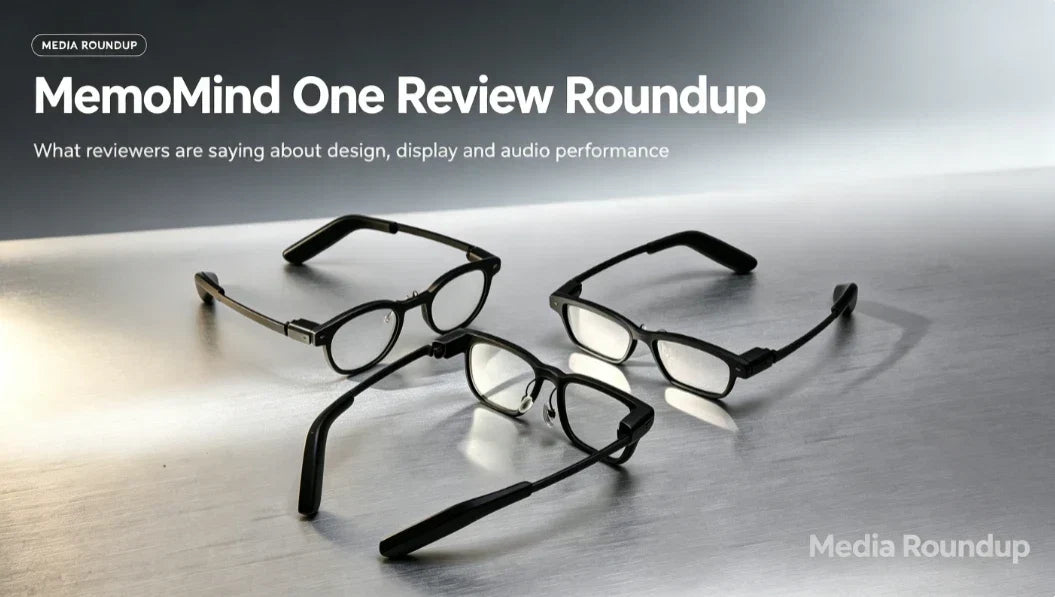
When people hear "smart glasses," they often think of cameras, photos, and video recording. MemoMind One is being reviewed for a different reason: breaking the mold as AI glasses that don't have a camera by design.
That makes the product easier to use in everyday situations. This roundup brings together recent media coverage to see what reviewers liked, what they questioned, and who MemoMind One may be for.
That makes the product easier to use in everyday situations. This roundup brings together recent media coverage to see what reviewers liked, what they questioned, and who MemoMind One may be for.
Quick Summary: What Tech Media Agreed On
Across selected media reviews, MemoMind One stood out for five reasons:
-
Camera-free design for users who prefer greater public privacy
-
Built-in display for captions, translation, navigation, and notifications
-
Open-ear audio for calls, music, and AI interaction
-
Prescription lens support and stylish customization options
-
AI features including translation, meeting assistance, and teleprompter
Reviewers also raised fair questions around privacy controls, AI memory features, and how mature AI glasses software needs to become before the category feels mainstream.
If you're new to MemoMind One, see our guide: What Is MemoMind One?
What Tech Media Says About MemoMind One
Android Central: Practical Display-first Smart Glasses
Android Central focused on MemoMind One as camera-free smart glasses that still offer a real visual interface.
The review highlighted the built-in waveguide display. Instead of relying only on voice responses, MemoMind One gives users a private visual layer for information they may want to read quickly.
That display-first approach is central to MemoMind One. The glasses are designed to show useful information in your field of view without making you constantly reach for a phone.
To learn more about the display system, read MemoMind Smart Glasses Display Resolution, Brightness, FOV & More.
GameRevolution: A Strong Camera-Free Alternative
GameRevolution gave MemoMind One an 8/10 and positioned it as a meaningful alternative to camera-based smart glasses.
For users searching for smart glasses without a camera, this is one of MemoMind One’s clearest differences. It does not try to replace camera-first AI glasses. It focuses on productivity, communication, and private information access.
BGR: Smart Glasses People May Actually Want to Wear
BGR tested MemoMind One over an extended period and framed the product around wearability.
The review praised the everyday design, frame options, ZEISS prescription lens support, Harman Kardon audio, live translation, meeting recording, teleprompter mode, notifications, and music playback.
This matters because smart glasses only work if people are willing to wear them. A device can have advanced AI features, but if it feels uncomfortable or socially awkward, it will not become part of daily life.
MemoMind One Pros and Cons Mentioned by Media
The overall media response was positive, but not entirely one-sided. Tom’s Guide raised questions around AI memory and wearable privacy. The Verge also noted that software still needs to mature.
Those observations appeared in several reviews. The hardware direction received praise, but reviewers generally agreed that AI wearables are still in the early stages of development. These aren't necessarily criticisms of MemoMind One itself. Instead, they reflect the growing pains of an entirely new product category.
That balance matters for buyers comparing camera-free smart glasses.
| Pros reviewers mentioned | Cons reviewers mentioned |
|---|---|
| Camera‑free design feels more discreet in public | AI features still need to become faster and more consistent |
| Private display is useful for information only the wearer needs to see | Some software experiences need more polish |
| Notifications, navigation, captions, and translation fit the smart glasses format well | Certain functions may still require using the mobile app |
| Open‑ear audio adds value for calls, music, and AI interaction | Display comfort and readability can depend on user fit and environment |
| Everyday frame design makes the product easier to wear | Open‑ear audio may not feel private in quiet spaces |
| Prescription lens support improves daily usability | Buyers who want photo or video capture will miss having a camera |
Is MemoMind One Worth Considering?
Based on these media reviews, MemoMind One seems best suited for people who want:
-
A private display for notifications, directions, and captions
-
Real-time translation during travel or multilingual conversations
-
Open-ear audio for calls and AI interactions
-
Smart glasses that don't include a built-in camera
-
A more discreet alternative to camera-first wearables
It may be less suitable for users whose priorities include photography, video recording, or camera-based visual recognition.
Related Blogs
More MemoMind stories from the same category.