Meta Display vs MemoMind One: Which AI Smart Glasses Are Worth Buying?
If you’re torn between Meta Ray-Ban Display and the emerging MemoMind One AI glasses, this side-by-side real-world comparison is built entirely on a reviewer’s long-term daily wear testing of both devices.
For context, the reviewer is a former product marketing guy on the Android side. "I’ve been a smart-glasses skeptic for years, and I’ve owned — and returned — more wearables than I’d like to admit. I use my Apple Vision Pro almost every day, so I’ll say it plainly: I’m exactly the kind of person who will happily try a product while it’s still rough around the edges," just as he said in his original review on Reddit.
In this article, he, as a Meta Display user for nearly four months, compared Meta Display and the emerging AI glasses MemoMind One from several aspects.
Design & Aesthetics: Tech Novelty vs. Everyday Eyewear
MemoMind One Looks More Like Normal Eyewear
This one genuinely surprised me.
Wearing the Meta Display alone, I thought it looked fine — a bit bulky, but I chalked it up to the “smart glasses tax.”
Then I put on the MemoMind One, walked past a mirror, and realized:
“Oh. This is what glasses are supposed to look like.”
I didn’t realize how much that mattered until I compared them side by side in public.

Meta Display (left) vs MemoMind One (right).
Temples & Frame Design
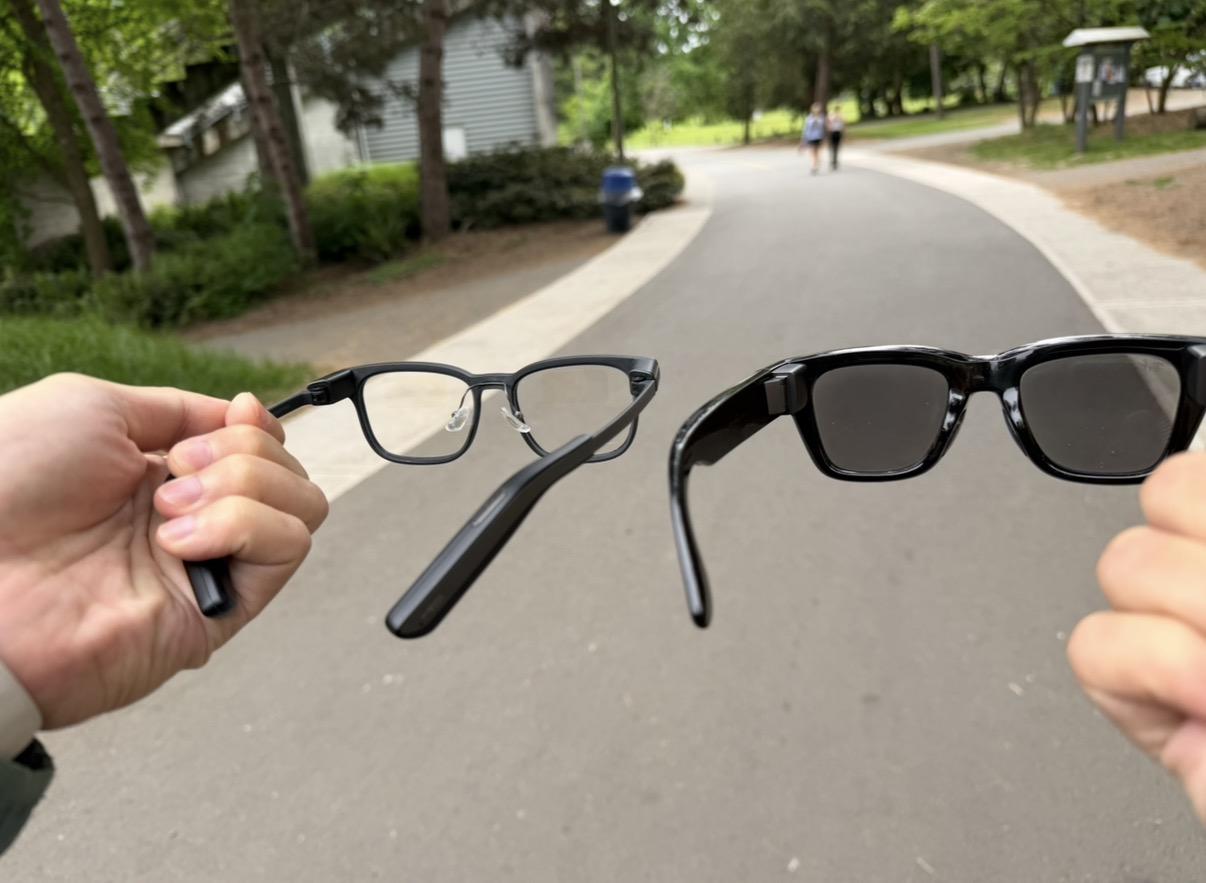
I also really like MemoMind’s temples. They genuinely look good as regular glasses.
In contrast, it’s harder to say Meta’s temples are visually appealing. They still feel noticeably “tech product” rather than eyewear.

MemoMind One (Left) vs Meta Display (Right) – And I actually like that Meta has the photochromic lenses.
Weight & Comfort: The Difference Isn't Just the Grams
Feels Surprisingly Close to Normal Sunglasses
Meta Display is heavier on paper — around 69g, while MemoMind One is about 48g.
But the surprising part, at least for me as a non-prescription glasses wearer, is that my regular Ray-Ban sunglasses are already around 40g.
That means MemoMind One feels much closer to normal eyewear than I expected.
In real life, the difference between wearing MemoMind One and a normal pair of sunglasses is barely noticeable.

Adjustable Nose Pads Matter More Than Weight
But the bigger comfort story isn’t really about grams.
It’s about adjustability.
Meta uses a fixed sunglasses-style bridge: take it or leave it.
MemoMind One has adjustable nose pads, so you can dial in the fit more like a real prescription frame.
Over longer wear, my Meta Display slowly starts sliding down my face, while MemoMind One stays in place much more consistently throughout my workday.

Display Quality: Indoor Beauty vs Outdoor Readability
Meta Display Has Better-Looking Graphics Indoors
Meta Display uses a more square-off, monocular display.
Indoors, it’s genuinely sharp and bright. No complaints there.
But outdoors, under direct sunlight, I often can’t read it clearly.
-
Walking
-
Traveling
-
Commuting
-
Navigation

Meta Display (left) vs MemoMind One (right).
Why MemoMind’s Green Monochrome Display Works Better Outside
MemoMind takes a very different approach.
The display is monochrome green, and compared to Meta, it sits slightly higher in the field of view, which I personally find more comfortable.
On paper, “monochrome green” sounds like a downgrade.
But in actual sunlight, green at the right wavelength is incredibly legible.
It’s not visually impressive in the "beautiful UI" sense.
But the information actually reaches your retina at noon.
Live Captions & Translation: The Feature I Use Most
Real-Time Captions Are Incredibly Useful
This is the feature I use most by a wide margin.
I especially like using it for captions while watching TV shows or movies.
And if you have family members who speak different languages, this can become genuinely useful surprisingly fast.

Meta Display (left) vs MemoMind One (right).
MemoMind Supports More Languages Than Meta
MemoMind’s translation system is not just one-way captioning.
You can actually have back-and-forth translated conversations with it.
The last time I checked, it supported around 26 languages — significantly more than Meta.
More importantly, the latency feels practical in real conversations.
AI Meeting Summary & Battery Life
MemoMind One Feels More Comfortable in Meetings
This is where the two products really split philosophically.
Meta has a camera.
But in work environments, cameras change the social dynamic immediately.
MemoMind has no camera at all.
And because of that, it feels much easier to wear naturally during meetings.

Meta Display (left) vs MemoMind One (right).
AI Meeting Summaries Actually Become Useful
MemoMind can capture audio and generate clean meeting summaries afterward.
Battery life sounds like one of those spec-sheet talking points until you actually rely on the product for work.
Then it becomes the difference between:
“This is genuinely useful.”
And:
“This is a novelty I forgot to charge.”
Long Memory & AI Journaling: The Most Underrated Feature
Didn’t Expect to Care About This Feature
This is one of the features I almost skipped writing about.
Because honestly, I didn’t expect it to matter much.
But now it might actually be one of my favorite parts of the product.

Passive Journaling Changes the Experience Completely
With MemoMind, I don’t really “journal” in the traditional sense.
I just talk throughout the day.
And over time, it slowly builds a memory layer in the background.
Reading my own journal in the morning has somehow become one of the small moments I genuinely look forward to.
Final Thoughts: Which Smart Glasses Do I Prefer?
After using both daily, I don’t think these products are really trying to do the same thing anymore.
Meta Display feels more consumer-tech focused:
-
Better audio
-
More visually polished UI
-
Camera-centric features
MemoMind One feels more productivity-focused:
-
Better outdoor readability
-
Better live translation
-
More comfortable all-day wear
-
Better meeting workflow
-
Surprisingly compelling memory/journaling features
The best smart glasses features weren’t the flashy demo moments.
They were the quiet, everyday moments that slowly became habits.
Related Blogs
More MemoMind stories from the same category.